|
|

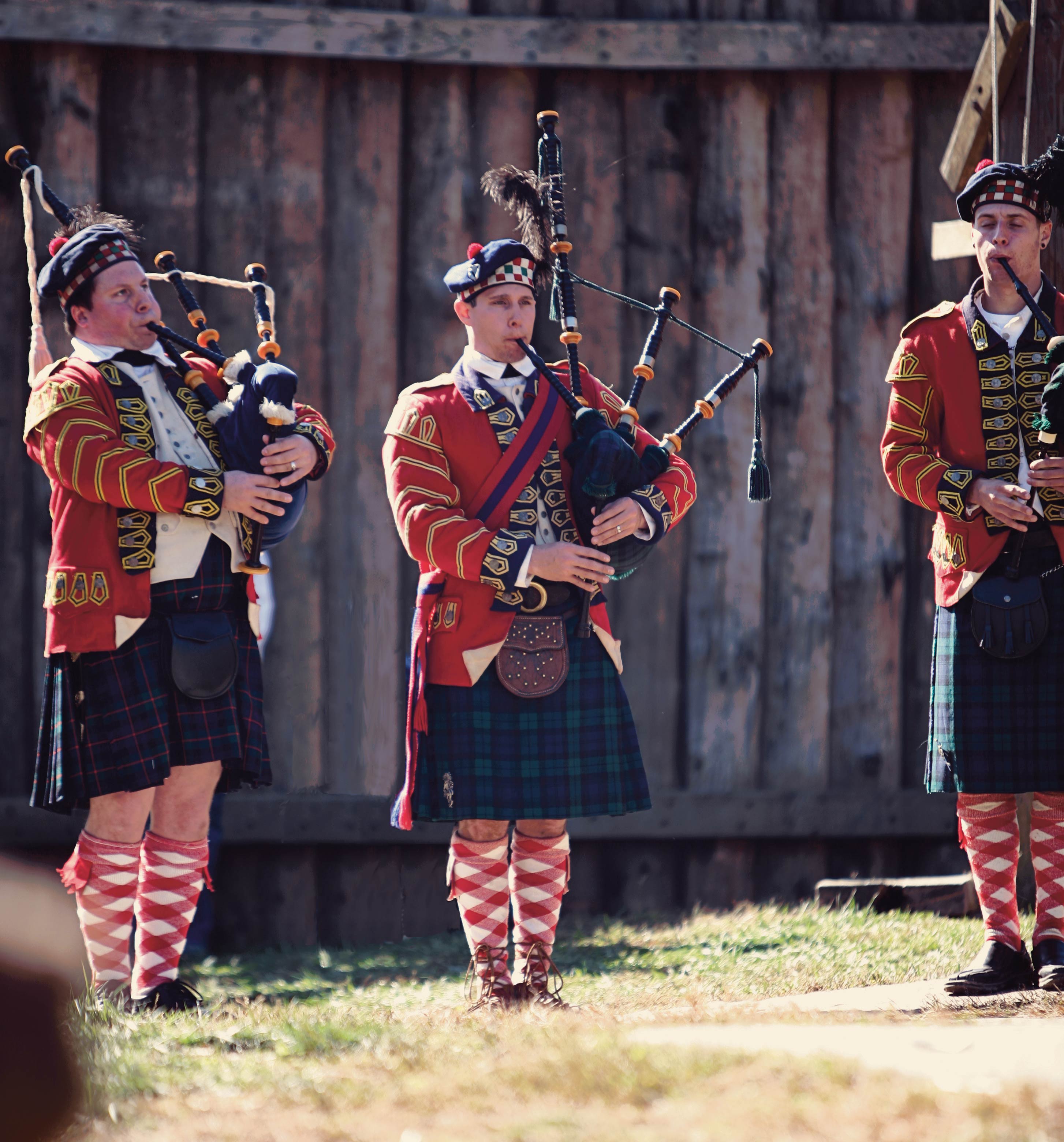
42nd Pipers, Fort Massac
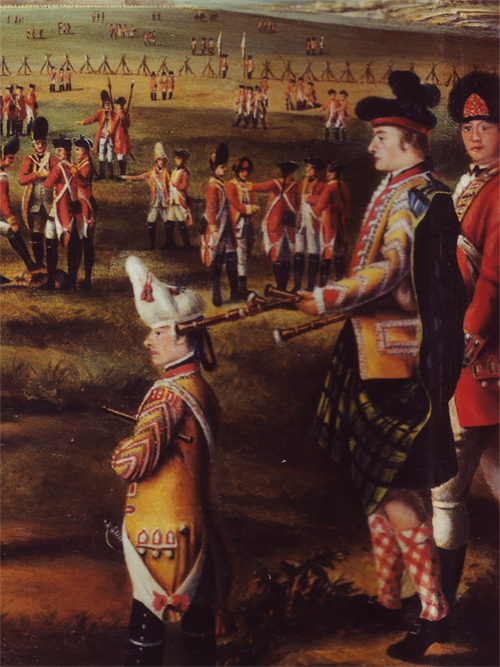
In much of the 18th century, the Army did not officially authorize pipers
for the highland regiments, but they were present: One of the Black Watch mutineers
in 1743 was piper Donald MacDonald; The 42nd was known to have
a piper attached to the grenadier company in 1759, who was appointed pipe
major, interesting if nothing else for the fact that he was appointed,
suggesting that there must have been more than two pipers. Additionally,
inspection returns of regiments show that in 1768, the 25th Foot "had a
bag piper in the Band of Music", and an inspection on 3rd August, 1774 reported that the 42nd had "two Pipers and a
very good band of music".2
By the American Revolution, two pipers were authorized and attached to the Grenadier company, but there were pipers in the line companies.
In September, 1776, between Long Island and White Plains, a piper was known
to have been killed in battle.3 A piper was wounded at Harlem Heights in 17764, and another killed at Fort Washington, also in 1776.4
The 1776 Muster for Maj. MacPherson's (line) Co. lists Drummers and Pipers in the slot usually listing drummers.6 A muster report in 1778 for Major Murray's Company names Robert MacFarland as a piper.5 In the same muster, Major Grant's company "listed Archibald McLachan, whose discharge papers indicate he was a piper."
Additionally, a 1775 Edinburgh Newspaper ad reported that the regiment was raising 12 pipers for the 42nd, paid as drummers. 7
For more about the long history of the bagpipes themselves, read on.
Additionally, please read our blog articles (part 1), (part 2) studying the history and particularly the dress of pipers in the late-18th century 42nd.
Footnotes:
1 Cuthbertson, Chap. IV, Sec XI, XII, XIII
2 Camus, Military Music, Appendix A
3 Cannon, Historical Record
4 Stuart, Sketches...
5WO 12/5479
6Paul Pace, personal communication, January 16, 2013
7Edinburgh Advertiser, Oct. 27, 1775
psmith@42ndRHR.org
http://www.42ndRHR.org
Last modified: April 12, 2021
Copyright © 2013
Preston M. Smith and the 42nd Royal Highlanders, Inc.
All rights reserved.
Blog |
Main Page |
Pipes |
Fifes |
Drums |
Dancing |
Escort to the Colors |
Pictures |
Booking the 42nd |
History |
Maps |
DeChartres |
Ireland |
Uniforms |
Warrants & Inspections |
Rev. War Officer Lists |
Links |
Bibliography |
42nd Recordings |
42nd Merchandise |
Griffin Endowment |
Scottish Society |
Burns Supper |
Forfar Bridie Booth |
The Whole 9 Yards |
Golf Outing |
2013 Tour of Scotland
|