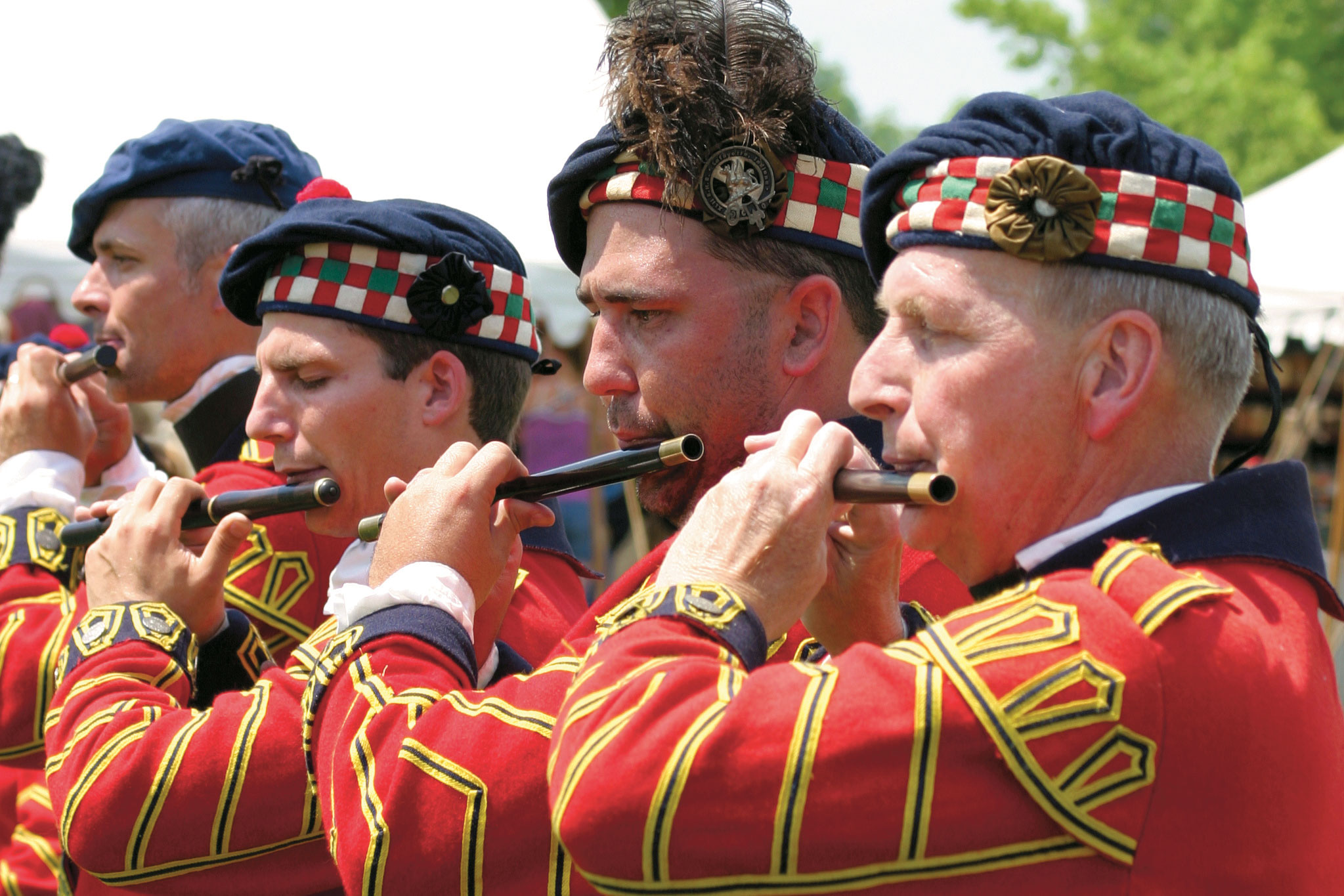
Fifes in the 18th century Field Music
In 1745, the fife was reintroduced to the British army by a young Hanoverian who was given by his colonel to a British couterpart. 1From this point on, the use of young boys as fifers was common. The Regimental Drum Major Association makes available the British Army's Infantry Drummer's Handbook, which contains a wealth of information about the history of the drums in the military in general and the British Army in particular. Sections on flutes and fife in the British Army are also included in this manual. Cuthbertson's recommendations for selecting drummers apply to fifers as well, except for the age requirement: "As their duty is not very laborious, it matters not how young they are taken, when strong enough to fill the Fife, without endangering their constitutions".2 Only the grenadier companies of British regiments were officially allowed fifers, meaning that with two drummers per companies, and ten companies, there were twenty drummers and two fifers.3 Some accounts note that despite the regulations, some regiments had from 4 to 6 fifers and twice as many drummers. In 1773, the 54th Regiment was noted to have "5 more fifers than the King's Regulations"4 The fife major had similar responsibilities over the fifers as the Drum-major did over the drummers. The drum major was the senior of the two. Fifers carried a brass fife case to their side. British fife tunes are scarce, there are few scores of the tunes played with the drum beatings, but several American tunes of the era are known.
The instrument todayThe fife can play surprisingly well with bagpipes, though it has a far greater range. (A good fife can reach 3 full octaves.) A B-flat fife, the most common, can play pipe music transposed down 4 steps. It can carry nearly as well as a bagpipe, and with its shriller tone, creates an interesting blend with the pipes.The majority of fifes are wood, usually rosewood, though ebony and cocobolo are not uncommon. Most have six holes, which is common for most players, but some fifers, however, will play one with 10 or 11 holes. 10 or 11 hole fifes are generally two-piece and tunable, but are a much newer instrument than the 6-hole fife. To learn more, visit Be a Fifer The 42nd plays Peeler Fifes. Footnotes: 1 Camus, Military Music, Chap. 1, p16 2 Cuthbertson, Chap. IV 3 Camus, Military Music, Chap. 1, p17 4 Camus, Military Music, Appendix A psmith@42ndRHR.org http://www.42ndRHR.org Last modified: April 12, 2021 Copyright © 2013 Preston M. Smith and the 42nd Royal Highlanders, Inc. All rights reserved.
|