|
|


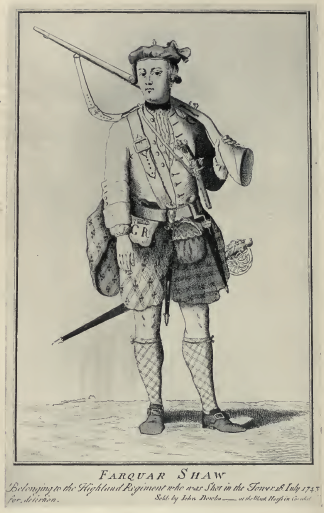
Private Farqhuar Shaw
- 25 October, 1739
- The companies of the Highland (Black) Watch, from the Independent Companies raised in 1729, ordered by Royal warrant formed into 43rd regiment under John, Earl of Crawford and Lindsay.
- May, 1740
- Regiment assembled for the first time, in Perthshire between Taybridge and Aberfeldy.
- 1740
- Lord Crawford to Life Guards, Brigadier Lord Sempill assumes colonelcy.
- Winter, 1741 - March, 1743
- Regiment returned to Highlands and resumed duties formerly performed
by the Highland Watch.
- March, 1743
- Regiment assembles in Perth, with orders to march to London. This is not well recieved by the Highlanders - but unrest is calmed by explaining that the King merely wishes to see a Highland regiment, which he has never seen.
- April, 1743
- Regiment marches through Scotland and England, and was an object of interest everywhere it marched.
- 29-30 April, 1743
- Regiment arrives in London. Immense crowds gather to see the Highlanders.
- May, 1743
- The King was on the Continent, and rumors spread among the men - that the regiment was being sent to the West Indies, or that it was a ploy to round up Jacobites and get them out of Scotland.
- 14 May, 1743
- Reviewed by Marshal Wade and other "persons of distinction", who were favorably impressed.
- 17 May, 1743
- Mutiny begins - that night, deserters gathered near Highgate and set out on the march to the north.
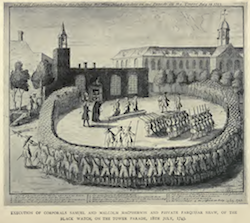
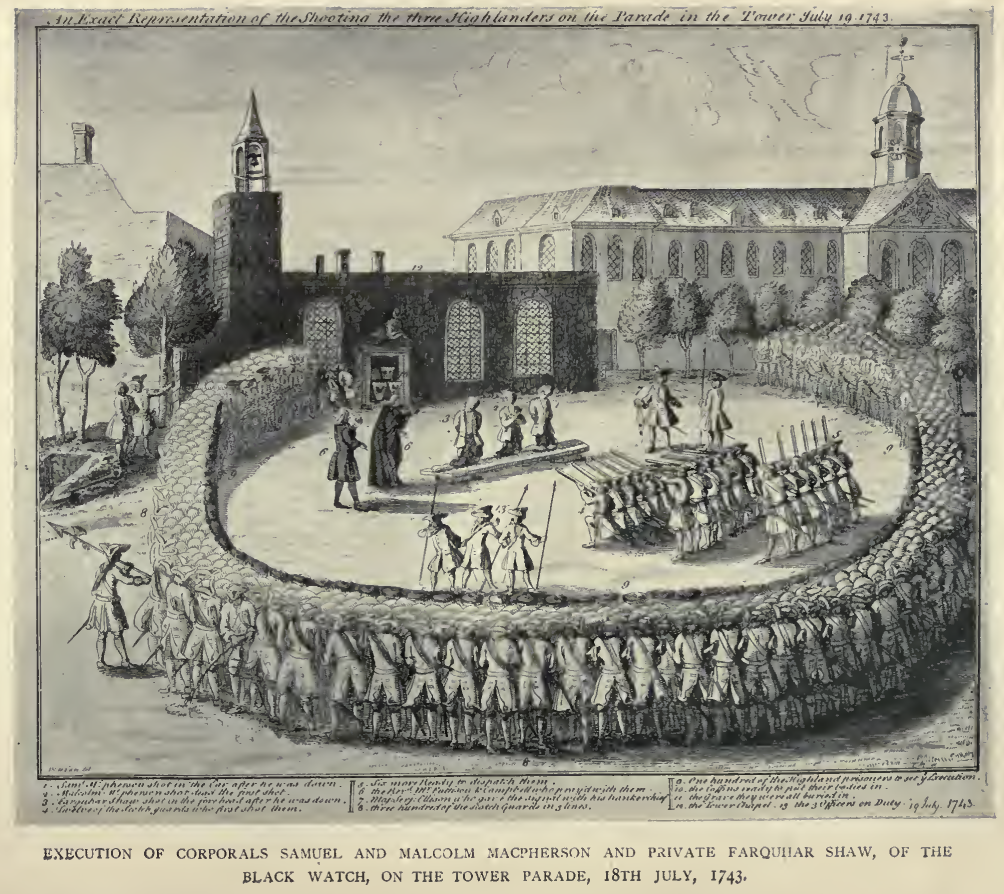
Execution of McPhersons and Shaw, 1743
- 19 May, 1743
- a troop of General Wade's Regiment of Horse (2nd Queens Regiment of Dragoon Guards) - led by Captain Ball, finds the deserters at Lady Wood. Ball led some negotiations: Highlanders wished to retain their arms and receive a full pardon, saying they would rather be cut to pieces than surrender. Bit by bit, the deserters were persuaded to surrender.
- 8 June, 1743
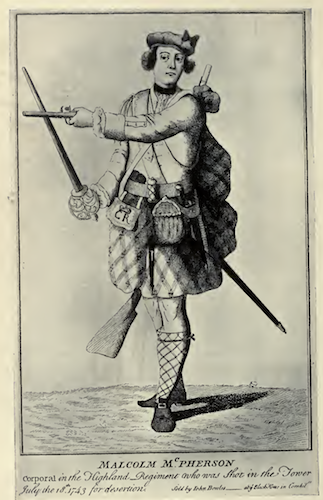
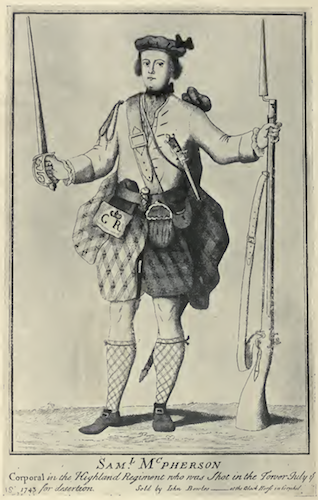
- Deserters all tried by court-martial, found guilty, and sentenced to be shot. The capital portion was commuted for all but 3 men - Corporals Malcolm and Samuel McPherson, and private Farqhuar Shaw.
- 12 June, 1743
- Corporals McPherson and private Shaw executed at the Tower of London. Lord John Murray, who was later Colonel of the Regiment, had portraits of all three men hung in his dining room.
- 11 August, 1743
- Warrants issued that the deserters be dispersed to other corps abroad: 13 to Gibraltar, 13 to Minorca, 38 to the Leeward Islands, 38 to Georgia. (Records of the Mutiny in the Black Watch, pp 124-128)
- May, 1743
- Regiment to Flanders. No active fighting in 1743 or 1744, but was well regarded as trustworty with property, and were popular with the local inhabitants.
- April, 1745
- Lord John Murray made Colonel of the Regiment.
- 1744-1746
- Regiment served in the War of the Austrian Succession,
distinguishing itself at Fontenoy. Stewart of Garth tells a story of how the Duke of Cumberland grew very enamored at the valor and character of the Highlanders.

The 42nd at Fontenoy
- 4 November, 1745
- Regiment arrived in England, stationed near Kent to repel potential Jacobite invasion - far away from Scotland where loyalties certainly would have been questioned.
- 1745
- 3 new companies raised.
- 21 September, 1745
- one of the new companies involved at Battle of Prestonpans. After uprising, new companies serving as Highland watch, and was even ordered to burn and lay waste to houses and property of Scottish rebels.
- 1747
- Joined army in Flanders. Remained in Flanders through 1748
- December, 1748
- Returned to England.
- 1749
- Arrives in Ireland. Renumbered 42nd upon the elimination of Oglethorpe's Regiment.
- 1749-1756
- Service in Irish Establishment, demonstrating the same character shown at Fontenoy and Flanders.
- 1755
- Seven years' War (French and Indian War) begins.
See
here for more general information about the war.
- 1756
- 42nd comes to America, spends remainder of 1756
inactive in Albany.
- Winter/Spring 1757
- Regiment drilled for bush fighting and
sharpshooting.
- July-August 1757
- Regiment sent to Halifax with 22nd, 44th, 48th, and 2 battalions of the 60th and 600 rangers to participate in planned attack on
Louisbourg. The force was to be met by Fraser's and Montgomery's Highlanders and the 43rd, 45th, and 55th, which recently arrived from England. Returned to Albany after the attack was aborted
due to a superior French naval presence.

The 42nd at Ticonderoga
- 5 July, 1758
- Force of 15,000 men (6,000 regulars) in nine hundred small boats and one hundred and thirty-five whale-boats, with artillery mounted on rafts, embarked on Lake George.
- 6 July, 1758
- Army advances on forward positions at Ticonderoga
- 8 July, 1758
- British forces engage Montcalm's French at Ticonderoga.
42nd participates in legendary charge on French lines and attempt to
storm the breastwork, with the following losses: 8 officers, 9 sergeants and 297 killed; and 17 officers, 10 sergeants and 306 soldiers wounded. The officers killed were Major Duncan Campbell of Inveraw, Captain John Campbell, Lieutenants George Farquharson, Hugh MacPherson, William Baillie, and John Sutherland; Ensigns Patrick Stewart of Bonskied and George Rattray. The wounded were Captains Gordon Graham, Thomas Graham of Duchray, John Campbell of Strachur, James Stewart of Urrad, James Murray; Lieutenants James Grant, Robert Gray, John Campbell of Melford, William Grant, John Graham, brother of Duchray, Alexander Campbell, Alexander Mackintosh, Archibald Campbell, David Miller, Patrick Balneaves; and Ensigns John Smith and Peter Grant.
"The battle was not regarded as a
disaster, but as a triumphant display of Highland gallantry. Though it
achieved nothing, it showed a heroic temper, and without a heroic
temper, an army is worth very little."
Eric and Andro Linklater, "The Black Watch" (London: 1977)
Stewart of Garth quotes this letter from an officer of the 55th:
"With a mixture of esteem, grief and envy, I consider the great loss and immortal glory acquired by the Scots Highlanders in the late bloody affair. Impatient for orders, they rushed forward to the entrenchments, which many of them actually mounted. They appeared like lions, breaking from their chains. Their intrepidity was rather animated than damped by seeing their comrades fall on every side. I have only to say of them, that they seemed more anxious to revenge the cause of their deceased friends, than careful to avoid the same fate. By their assistance, we expect soon to give a good account of the enemy and of ourselves. There is much harmony and friendship between us." "The attack (says Lieutenant William Grant of the 42nd) began a little past one in the afternoon, and, about two, the fire became general on both sides, which was exceedingly heavy, and without any intermission, insomuch that the oldest soldier present never saw so furious and incessant a fire. The affair at Fontenoy was nothing to it. I saw both. We labored under insurmountable difficulties. The enemy's breastwork was about nine or ten feet high, upon the top of which they had plenty of wall pieces fixed, and which was well lined in the inside with small arms. But the difficult access to their lines was what gave them the fatal advantage over us. They took care to cut down monstrous large oak trees, which covered all the ground from the foot of their breastwork about the distance of a cannon shot every way in their front. This not only broke our ranks, and made it impossible for us to keep our order, but put it entirely out of our power to advance till we cut our way through. I have seen men behave with courage and resolution before now, but so much determined bravery can hardly be equalled in any part of the history of ancient Rome. Even those that were mortally wounded cried aloud to their companions, not to mind or lose a thought upon them, but to follow their officers, and to mind the honor of their country. Nay, their ardor was such, that it was difficult to bring them off. They paid dearly for their intrepidity. The remains of the regiment had the honor to cover the retreat of the army, and brought off the wounded, as we did at Fontenoy. When shall we have so fine a regiment again? I hope we shall be allowed to recruit."
- 22 July, 1758
- 42nd given 'Royal' designation. While the warrant was issued
on July 22, it was planned and issued before London had recieved
word of the battle at Ticonderoga, rather than in response to Ticonderoga as is sometimes said.
View the text of the
warrant that gave the Regiment its Royal distinction.
- October 1758
- 2nd battalion raised. So successful were the recruiting officers that within three months, seven companies, each one hundred and twenty men strong were embodied at Perth. Although Highlanders only were admitted, yet two officers, anxious to obtain commissions, enlisted eighteen Irishmen, several of whom were O'Donnels, O'Lachlans, O'Briens, &c. The O was changed to Mac, and the Milesians passed muster as true Macdonels, Maclachlans, and Macbriars, without being questioned.
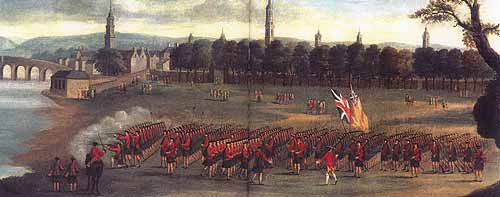
2nd Battalion at Glasgow Green, 1758
- Winter 1758
- Spend winter rebuilding ranks on Long Island.
- January - 2 July 1759
- 2nd Bn. sent to West Indies, where it fought at Martinique and
Guadaloupe. 193 of 700 men lost, as well as 25% of the battalion's officers, many to ilness from the tropical weather.
- 12 January, 1759
- 5 companies of 2nd Bn. sails with fleet from Barbados to Martinique.
- 16 January, 1759
- 2nd Bn. and fleet arrive in Fort Royal bay. Forces land and spend several days on the island.
- 20 January, 1759
- British forces re-embark and sail for Guadeloupe.
- 23 January, 1759
- British fleet bombards Fort Royale, setting portions of it on fire.
- 24 January, 1759
- 2nd Bn. guards artillery camp north of town.
- 14 February, 1759
- 2 companies of the 2nd Bn. - Late to campaign in West Indies after being separated at sea - land at and take Fort Louis, Guadeloupe.
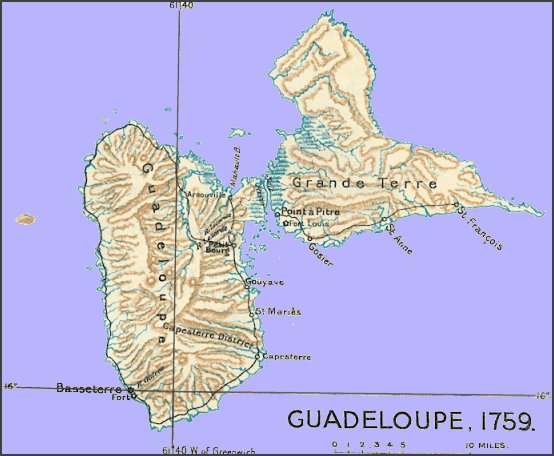
Guadeloupe, 1759
(John Fortescue's History
of the British Army Volume 2)
- 11 March, 1759
- 5 companies of 2nd Bn. with main fleet joins other 2 companies at Fort Louis.
- 12 April, 1759
- All 7 companies of the 2nd Bn., together for the first time, engage the French at the river Licorne. The Highlanders attack with swords, driving away the French and taking 70 prisoners.
- 19 April, 1759
- Army marched to Capesterre district, where the inhabitants surrendered the island.
- 11 May, 1759
- Part of 1st Bn. encamped above Albany.
- 12 May, 1759
- Amherst notes in his journal that he deployed one company of the 1st Bn to Scorticock to guard oxen being sent off to graze.
- 20 May, 1759
- 200 of the 42nd escorts batteax up the Hudson.
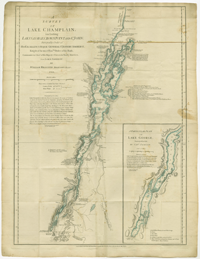
Lake Champlain
- 23 May, 1759
- Amherst records that 2 companies of 1st Bn. up river to encamp at Stillwater.
- 1 June, 1759
- Amherst orders remainder of 42nd, among others, to Fort Edward.
- 7 June, 1759
- 42nd arrived at Fort Edward "half drowned", according to Amherst.
- 19 June 1759
- 42nd, Montgomery's Highlanders assembled at Fort Edward.
- 22 June, 1759
- 1st Bn. encamped on southern edge of Lake George.
- 15 July, 1759
- 2nd Bn. arrives at New York from West Indies.
- 22 July, 1759
- Amherst's army arrives at Ticonderoga.
- 26 July, 1759
- French forces withdrew from Ticonderoga and set fire to the fort.
- August/Sept 1759
- 1st Bn. reconstructing Fort Crown Point.

Fortifications at the
mouth of the Oswego River
- 1 August, 1759
- Amherst sends Major Graham to Oswego to command 2nd Bn.
- 3 August, 1759
- 2nd Bn. marches along the Hudson from Albany to join the rest of the army. Graham meets the Bn. and turns them back to Albany, up the Mohawk towards Oswego.
- Late August, 1759
- 2nd Bn. arrives at Oswego, and put to work building Fort Ontario
- Winter, 1759
- 2nd Bn. brought in together with the 1st Bn. in Albany for the winter, primarily at Fort Edward, with companies at Halfway Brook, Fort Miller, Saratoga, Stillwater, and Half Moon. (Sons of the Mountain, vol 1, p 164)
- 7 August, 1760
- 1st Bn., Grenadiers, Light Infantry take post at La Galette
- 10 August, 1760
- Army embarks up the St Lawrence towards Montreal.
- September, 1760
- Both battalions served in the army under Amherst, which moved
down the St. Lawrence. Recieved the surrender of Montreal, together with that of the French Governor-General and the French army.

Surrender of Montreal
- Winter 1760-61
- Both battalions remained in Montreal for the winter.
- 4 April - 5 August, 1761
- Moved from Montreal to Staten Island, to set out for West
Indies.
- 1761
- Regiment leaves America for Barbados to join armament against
Martinique and Havana.
- 1762
- War declared on Spain.
- 5 January, 1762
- Regiment leaves Barbados for Martinique.
- 8 January, 1762
- Fleet anchored in St. Ann's Bay, Martinique
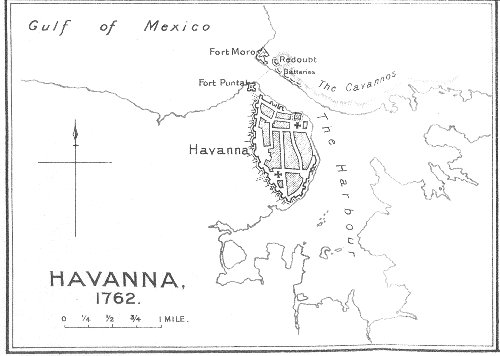
British Map of Havana
(John Fortescue's History
of the British Army Volume 2
- 16 January, 1762
- Army landed in Cas de Navire, set out to take high ground overlooking Fort Royal.
- 5 February, 1762
- Surrender of Port Royal. Followed shortly by Grenada, St. Vincent, St. Lucia. Losses by the 42nd: Captain William Cockburn, Lieutenant David Barclay, 1 sergeant and 12 rank and file killed; Major John Reid, Captains James Murray and Thomas Stirling, Lieutenants Alexander Mackintosh, David Milne, Patrick Balneaves, Alexander Turnbull, John Robertson, William Brown, and George Leslie, 5 sergeants, 1 drummer, 72 rank and file wounded.
Stewart of Garth
- June, 1762
- 42nd takes part in capture of Havana. 42nd suffered losses of 2 drummers and 6 privtes killed, 4 privates wounded. Sickness took Major MacNeil, Captains Robert Menzies and A. MacDonald, Lieutenants Farqhuarson, Grant, Lapsely, Cunnison, Hill, Blair, 2 drummers, and 71 rank and file. Following capture of
Havana, 2nd Bn. was reduced and combined with 1st Bn.
- October, 1762
- Regiment returns to New York.
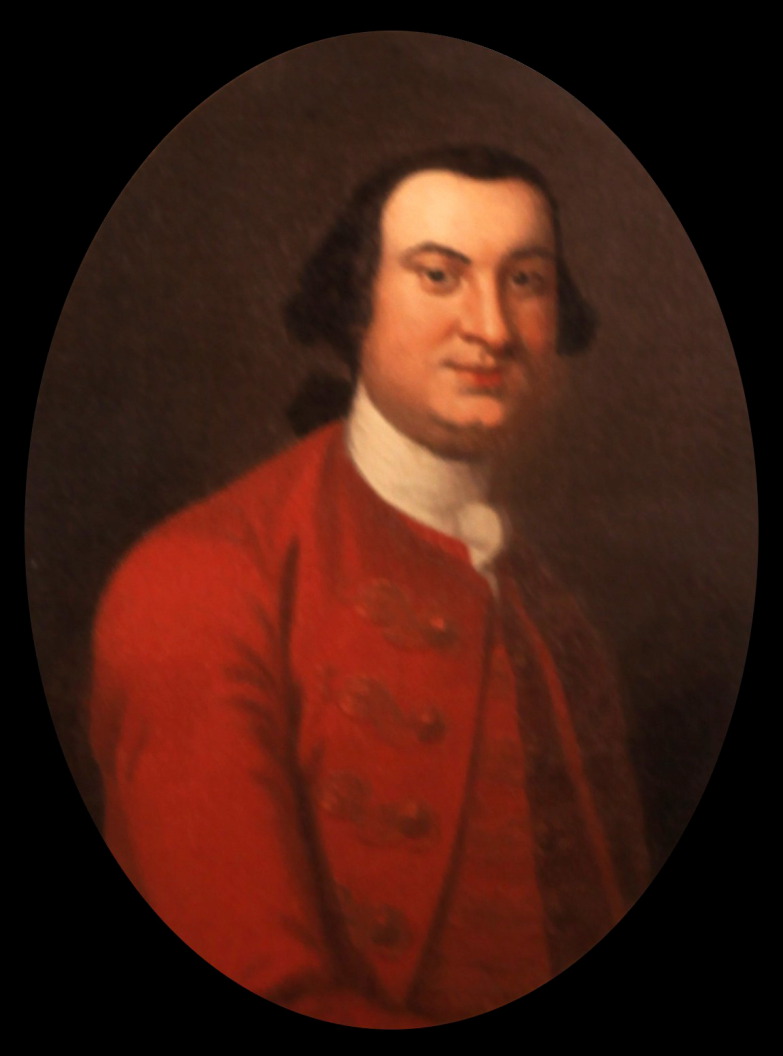
Col. Henry Bouquet
- 1763
- Regiment selected to force led by Henry Bouquet protecting North American colonies, with a detachment of Montgomery's Highlanders, and the 60th.
- July 1763
- 42nd sent to the relief of Fort Pitt.
- 25 July, 1763
- Reached Fort Bedford, PA.
- 28 July, 1763
- Marched for Fort Ligonier.
- 2 August, 1763
- Bouquet expedition reaches Ligonier, relieving the garrison there.
- 5 August, 1763
- Light and grenadier companies, along with Henri Bouquet's
Royal Americans, ambushed by Indians at Bushy Run.
The 42nd suffered losses of Lieutenants John Graham and James Mackintosh, 1 sergeant, and 26 rank and file killed; and Captain John Graham, Lieutenant Duncan Campbell, 2 sergeants, 2 drummers, and 30 rank and file wounded.
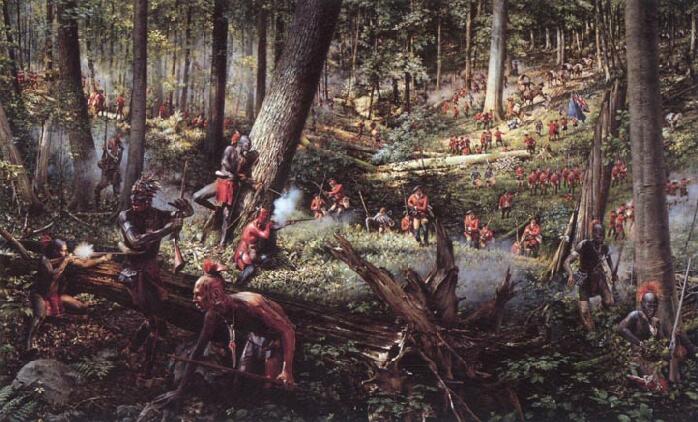
Ambushed at Bushy Run, 1763
- 28 November, 1763
- Arrived at Fort Pitt.
- 1 December, 1763
- 3 companies of the 42nd stayed at Fort Pitt. Bouquet notes in a letter to Gage that for the winter, the rest of the regiment sent to other posts in the area: 1 company to Fort Ligonier, 1 to Fort Bedford, and 3 companies to Carlisle.
- Winter 1763-1764
- Spent winter at Fort Pitt.
- Summer 1764
- 8 companies sent with a force under Col. Bouquet against
Ohio Indians, along with 60th regiments's Light co., 600 Virginia Marksmen, and a detatchment from Maryland and Pennsylvania dressed in the manner of the Indians.
- 13 October, 1764
- Expedition reached Tuscarawas River in Ohio.
- Late October, 1764
- Expedition moved to Muskingum River.
- 18 November, 1764
- Departed for Fort Pitt
- 30 November, 1764
- Upon return to Fort Pitt, Bouquet writes to Gage:
Fort Pitt is garrisoned by Five Companies of the 42d Regt under the Command of Captain William Murray.
Fort Ligonier has a Company of the Same Corps under the Command of Captain Stewart.
Fort Bedford another Company commanded by Captain William Grant.
Fort Cumberland half a Company under the Command of Lt McIntosh.
Fort Loudoun the other half Comp. under the Command of Lt Eddington.
(Alvord, The critical period, 1763-1765)
- August, 1765
- Captain Thomas Stirling leads a detachment of 100 men down
the Ohio, where they took possession of
Fort Chartres in October.
The detachment remained at Chartres for the winter.
- 1766
- Part of the regiment leaves Fort Pitt for Philadelphia, and were joined by the
Illinois expedition in June. After 10 months and 3000 miles, every
man of the Illinois detachment returned in perfect health.
- February 22, 1767
- A letter from Gage showing the distribution of troops in North America reports that 6 companies of the 42nd were stationed in Philadelphia, and 3 were still at Fort Pitt.
Losses in the French and Indian War
| KILLED |
WOUNDED |
|
|
Fed.
Officers
|
Capts.
|
Subal
terns
|
Serj
eants
|
Drum
mers
| Priv
ates |
Fed.
Officers
|
Capts.
|
Subal
terns
|
Serj
eants
|
Drum
mers
|
Priv
ates
|
| Ticonderoga, July 7, 1758
|
1
|
1
|
6
|
9
|
...
|
267
|
...
|
5
|
12
|
10
|
...
|
306
|
| Martinique, January, 1759
|
...
|
...
|
...
|
...
|
...
|
8
|
...
|
...
|
1
|
2
|
...
|
22
|
| Guadeloupe, February and March, 1759
|
...
|
...
|
1
|
1
|
...
|
25
|
...
|
...
|
4
|
3
|
...
|
57
|
| General Amherst's Expedition to the Lakes, July and August, 1759
|
...
|
...
|
...
|
...
|
...
|
3
|
...
|
...
|
...
|
1
|
...
|
4
|
| Martinique, January and February, 1762
|
...
|
1
|
1
|
1
|
...
|
12
|
1
|
1
|
7
|
3
|
1
|
72
|
| Havanna, June and July, 1762, both battalions.
|
...
|
...
|
...
|
...
|
1
|
3
|
...
|
...
|
...
|
...
|
1
|
4
|
| Expedition under Colonel Boquet, August, 1763
|
...
|
1
|
1
|
1
|
...
|
26
|
...
|
1
|
1
|
2
|
2
|
30
|
| Second Expedition under Boquet, in 1764 and 1765
|
...
|
...
|
...
|
...
|
...
|
7
|
...
|
...
|
...
|
1
|
...
|
9
|
| Total in the Seven Years War
|
1
|
3
|
9
|
12
|
1
|
351
|
1
|
7
|
25
|
22
|
4
|
504
|
- July, 1767
- Left Philidelphia for Cork, Ireland.
- 1769
- Regiment stationed in Dublin.
- 1770
- Regiment stationed in Donaghadee and Belfast. Three companies
also stationed in the Isle of Man.
- 1771
- An additional company raised.
- 1772
- Regiment used to keep peace between Catholics and Protestants
in Antrim, and other places in Ireland. The 42nd was particularly
good at this particular service, to due their knowledge of the
Irish tongue, conciliating conduct towards the Irish, with whom
they shared a common background.
- 1775
- 42nd returned to Scotland, gaining two companies.
- 10 April, 1776
- Inspected by General Oughton - total strength of 921 Highlanders, 74 Scotch Lowlanders, 3 English, 1 Welsh, and 2 Irish.
- 1 May, 1776
- Sailed for America (Boston) with Frasers in a fleet of 33 ships. Convoy scattered in Atlantic early in voyage.
- 29 May, 1776
- Transports Oxford and Crawford captured by Continental Navy Brig Andrea Doria (Captain Nicholas Biddle).
- 10 June, 1776
- Capt. Peebles notes that 6 ships together with his transport sighted Cape Cod from masthead. Informed that Howe's army had left Boston for Halifax. Fleet sailed for Halifax.
- 23 June, 1776
- Reached Halifax. Discovered on 24th the fleet and army had left Halifax, destination yet unknown.
- 24 June, 1776
- General Greene notified Washington that "the Scotch prisoners, with their baggage, have arrived at my Quarters." The list of prisoners are thus given:
"Forty second or Royal Highland Regiment: Captain John Smith and Lieutenant Robert Franklin... "
(Am. Archives, Fourth Series, Vol. VI, p. 1055.)
Captured men would not rejoin the Regiment until 1778.
- 4 July, 1776
- Set sail southward, leaving Halifax.
- 21 July
- Peebles notes that rumor of "bad accounts of some of our Transports" had reached the fleet - no doubt the Oxford and Crawford
- 28 July
- Word reaches fleet that Howe is on Staten Island, and Burgoyne in Albany. Fleet with 42nd, Frasers, 2nd Foot Guards is off Nantucket Shoals
- 5 August, 1776
- Regiment landed on Staten Island.
- August, 1776
- Grenadiers of 42nd and 71st formed into 4th Grenadier Battalion. Captain Peebles appointed Adjutant of combined Bn. Light company joins those of the 7th 22d 33d 37th 42d 54th 63d 70th 74th into 1st Light Battalion under Lt. Col. Robert Abercromby, of the 37th. Bonnet companies of the regiment, under Lt. Col. Stirling, assigned to reserve brigade under Cornwallis, with 33rd, 1st, 2nd, 3rd, and 4th Grenadier Battalion s, and Royal Artillery.
- 27 August, 1776
- Battle on Long Island and Brooklyn. Losses of Lieutenant Crammond and nine rank and file wounded at Long Island.
- 15 September, 1776
- Landing at Kip's Bay. With Hessians, captured force of New Englanders and Virginians. Stewart of Garth tells the following story of the night of the 15th:
"This night Major Murray was nearly carried off by the enemy, but saved himself by his strength of arm and presence of mind. As he was crossing to his regiment from the battalion which he commanded, he was attacked by an American officer and two soldiers, against whom he defended himself for some time with his fusil, keeping them at a respectful distance. At last, however, they closed upon him, when unluckily his dirk slipped behind, and he could not, owing to his corpulence, reach it. Observing that the rebel (American) officer had a sword in his hand, he snatched it from him, and made so good use of it, that he compelled them to fly, before some men of the regiment, who had heard the noise, could come up to his assistance. He wore the sword as a trophy during the campaign."
- 16 September, 1776
- Battle of Harlem Heights ("York Island"). Stewart of Garth records that the 42nd
lost one sergeant and three privates killed, and Captains Duncan Macpherson and John Mackintosh, Ensign Alexander Mackenzie (who died of his wounds), and three sergeants, one piper, two drummers, and forty-seven privates wounded.
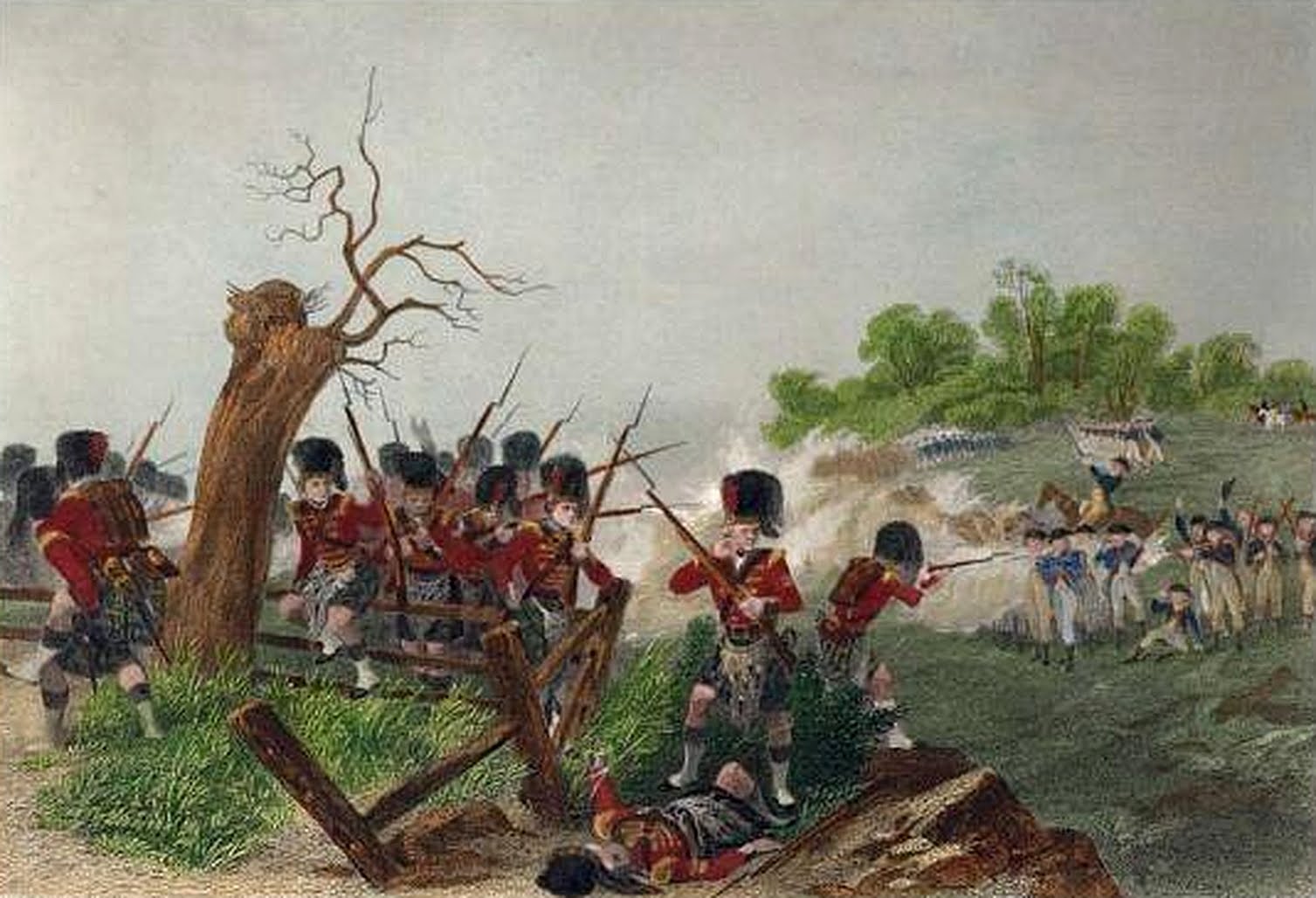
Battle of Harlem Heights
19th century print by JC Armytage
- November 16, 1776
- Fort Washington taken by British forces, including the 42nd. Despite being intended as a feint, rather than the main attack, the 42nd climbed the cliff-face and overran the American defenders.
Losses, according to Stewart of Garth were
1 sergeant and 10 privates killed, and Lieutenants Patrick Graeme, Norman Macleod, and Alexander Grant, and 4 sergeants and 66 rank and file, wounded.
A piper was killed at Fort Washington: "One of the pipers, who began to play when he reached the point of a rock on the summit of the hill, was immediately shot, and tumbled from one piece of rock to another til he reached the bottom."
- Winter 1776-1777
- Howe sets up a chain of outposts stretching from Perth Amboy to Bordentown, manned by the 42nd and Hessians.
- December 22, 1776
- Action at BlackHorse on the Delaware (Iron Works Hill)
- 6 January, 1777
- Regiment moved to Pisquata, New Jersey, an important location on the line of communication between New York and Cornwallis' headquarters at Brunswick.
Repelled a superior force of Americans attacking
provision wagons, for which they recieved an extra
ration of rum.
- February 13, 1777
- Grenadiers in Amboy, New Jersey, first of a series of skirmishes involving the 42nd in the New Jersey campaigns.
- March, 1777
- Grenadier company reassigned to 2nd Battalion Grenadiers.
- 17 March, 1777
- Captain Peebles notes St. Patrick's Day festivities:
usher'd in with St. Patricks day in the morng. at Reveilee beating, parade ashore at the usual hour, the Shamrogue mounted by the Hibernians, who dedicate the day to the Saint & the bottle or rather to St. for the sake of the bottle, we drank to his memory at dinner in the Cabin, but he was more amply sacrificed to between decks.
- May 10, 1777
- Battle of Pisquata, New Jersey. The regiment
fought bravely in this battle, receiving
special commendation
from Cornwallis. Losses were "3 sergeants and 9 privates killed; and Captain Duncan Macpherson, Lieutenant William Stewart, 3 sergeants, and 35 privates wounded. Stewart of Garth tells the story of Serjeant Macgregor:
"On this occasion, Sergeant Macgregor, whose company was immediately in the rear of the picquet, rushed forward to their support, with a few men who happened to have their arms in their hands, when the enemy commenced the attack. Being severely wounded, he was left insensible on the ground. When the picquet was overpowered, and the few survivors forced to retire, Macgregor, who had that day put on a new jacket with silver lace, having besides, large silver buckles in his shoes, and a watch, attracted the notice of an American soldier, who deemed him a good prize. The retreat of his friends not allowing him time to strip the sergeant on the spot, he thought the shortest way was to take him on his back to a more convenient distance. By this time Macgregor began to recover; and, perceiving whither the man was carrying him, drew his dirk, and, grasping him by the throat, swore that he would run him through the breast, if he did not turn back and carry him to the camp. The American, finding this argument irresistible, complied with the request, and, meeting Lord Cornwallis (who had come up to the support of the regiment when he heard the firing) and Colonel Stirling, was thanked for his care of the sergeant; but he honestly told him, that he only conveyed him thither to save his own life. Lord Cornwallis gave him liberty to go whithersoever he chose."
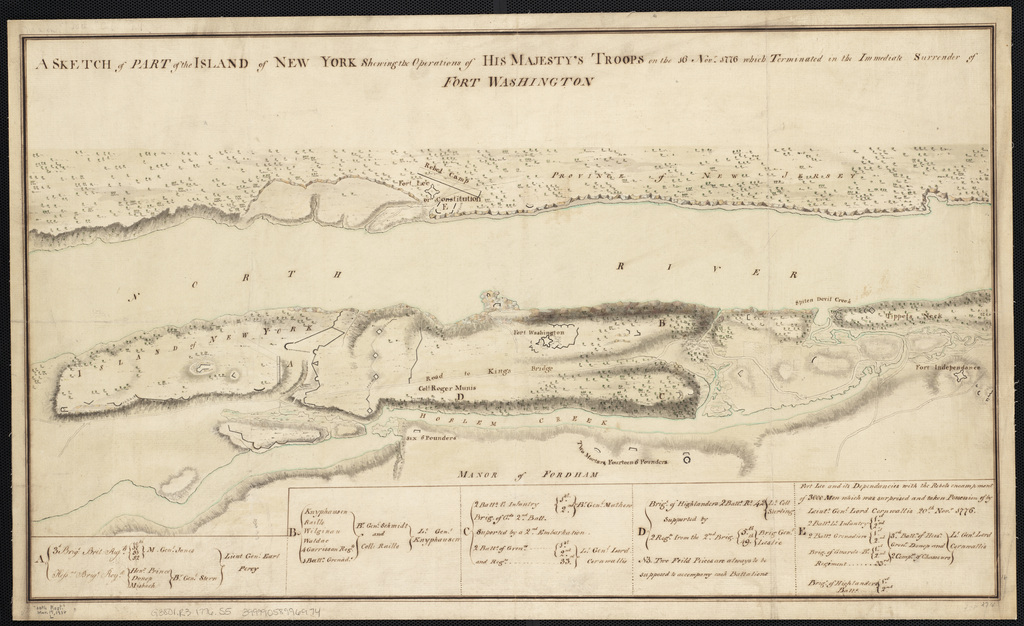
Map of Ft Washington
Boston Public Library)
- 12 June, 1777
- 42nd arrived at Brunswick, along with 33rd, 37th, 52nd, and others, according to Peebles.
- 13 June, 1777
- Army marched from Brunswick to Hillsboro in two divisions. Stirling commanding brigade of 42nd, 33rd, and some artillery.
- 1 July, 1777
- Army encamped on heights about Cole's Ferry, Staten Island.
- 8-9 July, 1777
- Army embarked at Cole's Ferry
- 16 July, 1777
- Fleet assembling off Staten Island.
- 20 July, 1777
- Fleet set sail - 260 vessels in total
- 30 July, 1777
- Fleet passed Cape Henlopen, Delaware
- 16 August, 1777
- Lying at anchor betwen Cape Henry and Cape Charles at the entrance to the Chesapeake
- 19 August, 1777
- Fleet passed the mouth of the Potomac
- 21 August, 1777
- Passed Annapolis, Peebles noted the Colours flying there
- 24 August, 1777
- Disembarked at the Elk River, Maryland. 42nd Disembarked with 28th, 49th, 5th, 10th, 27th,40th, 55th, and 15th
- 5 September, 1777
- Participated in a raid of privateer ships.
- 11 September, 1777
- Battle of Brandywine (Pennsylvania). Battalion companies were held in reserve and saw no action, but flank companies lost 4 privates killed, and 2 sergeants and 15 privates wounded.
- 22 September, 1777
- Howe ordered a detachment under General Charles Grey to attack "Mad" Anthony Wayne's camp, near the General Paoli Tavern near Valley Forge. The detachment included the 42nd, 44th, the 2nd light battalion, and some light dragoons. The detachment routed an entire US division with losses of only 4 killed and 7 wounded. Peebles notes
The Commander in Chiefs thanks to Majr. Genl. Gray and his detatchmt. for the steddiness in Bayonitting the Rebels without firing a shot.
- 3 October, 1777
- 42nd regiment was with the 10th (both under command of Stirling) to attack a post at Billingspoint, Jerseys, across from Mud Island. Letters from Major Baurmeister, say 28-29 September.
- 5 October, 1777
- Light Company participated in Battle of Germantown.
- 31 October, 1777
- John Peebles promoted to Captain Lieutenant, and leaves Grenadiers - joining the line companies.
- Early November, 1777
- Construction of floating gun batteries and seige of Fort Mifflin, on Mud Island, at the junction of the Delaware and Schuylkill Rivers. See mapsofpa.com for maps of the area.
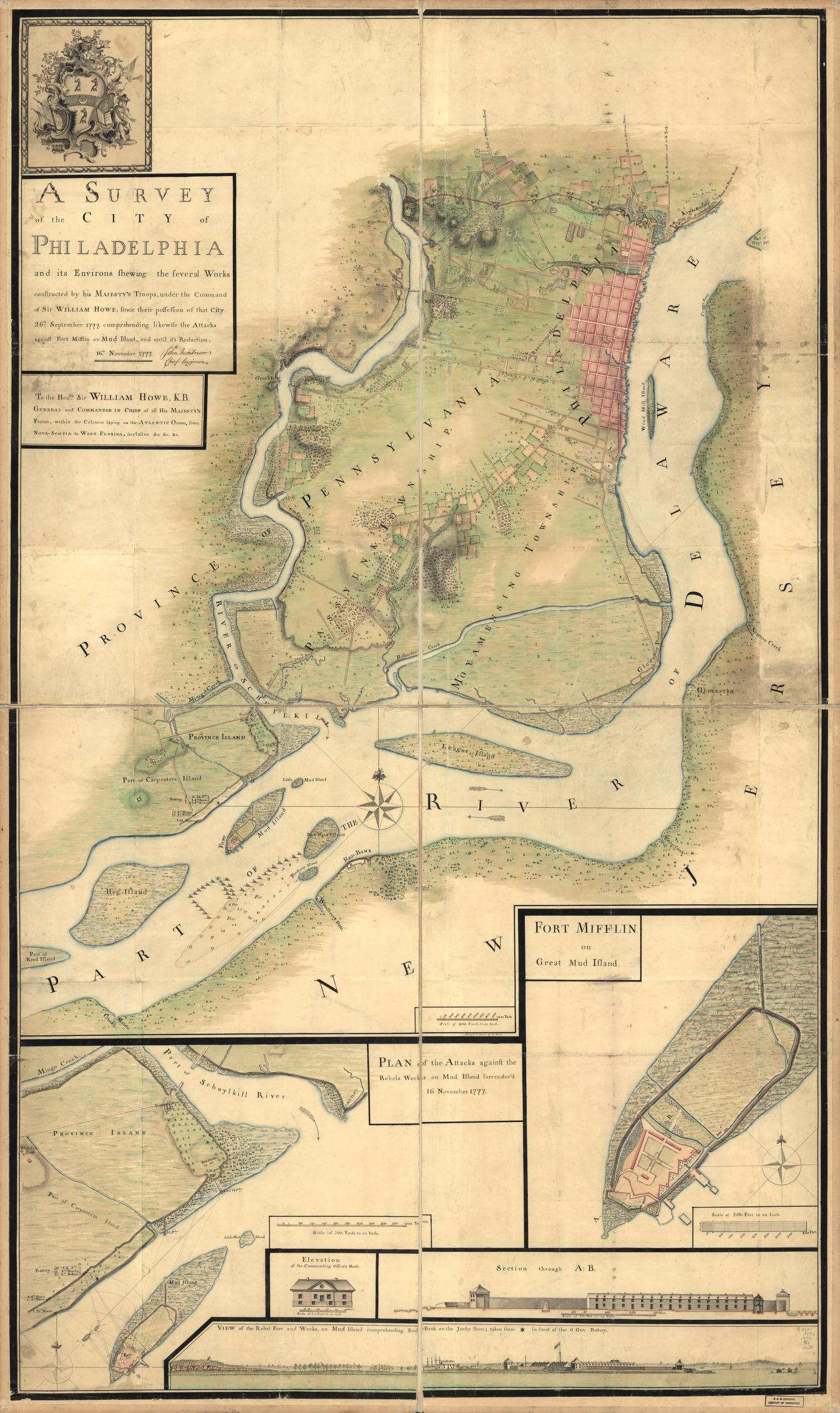
Map of Philadelphia,
including Mud Island
- Winter 1777-1778
- Encamped at Philadelphia for the winter. Peebles describes routine soldiering with duty patrolling the area, guarding redoubts, courts martial, etc.
- 17 March, 1778
- Peebles again notes St. Patrick's Day festivities:
St. Patrick's day, the Hybernians mounted the Shamrogue & an Irish Grenadr. personated St. Patrick in a Process thro' the Streets with a prodigious mob after him - the friends Brrs. and several other Irish Clubs dined together & dedicated the day to the St. and the Bottle
- 18 March, 1778
- Regiment takes to the field for the exercise in divisions. Peebles notes that shoes are in very bad shape. Scouting party encountered one of the Americans' near Germantown and killed 4 and took 12 prisoners.
- May 1778
- Howe recalled, replaced by General Clinton
- 28 June, 1778
- Battle of Monmouth, Jerseys.
- 4 July, 1778
- Peebles reports a great deal of firing of cannon and small arms, which were supposed to be "the Americans rejoicing on the anniversary of ye. Independence."
- July, 1778
- Regiment moves to Long Island. Throughout the month Peebles notes the French fleet present around New York.
- 27 July, 1778
- Peebles notes that he signed for a drummer that he knew nothing about, inserted into the rolls by Stirling. Peebles no doubt suspects that the rolls are being padded for extra funds from the government.
- 27 August, 1778
- Peebles promoted to captain in the Grenadier company.
- 1 September, 1778
- Sailed to Rhode Island
- 5 September, 1778
- 42nd, Grenadier Battalion, and light brigade sent to Fairhaven, MA, on the banks of the Acushnet river. Destroyed 70 vessels, with all the cargoes, stores, wharfs, and buildings.
- 28 September, 1778
- 42nd, in a column with Guards, 1st Bn Grenadiers under Cornwallis, marched to Tappan, NY, and found the village evacuated.
- 31 October, 1778
- Peebles notes that "the Regt. getting Brown trouzers of donation cloth, sent some of the Grrs. to get their measures taken..."
- 1 December, 1778
- Peebles: "a day when most wandering Scotchmn have a headach" [the day after St Andrew's Day ]
- 7 December, 1778
- March to Jamaica, Long Island, with the intent to intercept Burgoyne's captured army, which was being moved by the Americans.
- 8 January, 1779
- Peebles attends a ball in Jamaica - 16 Ladies present "Danced & talked nonsense with Miss Ogden, a good piece, came home tween 3 and 4 in a sleigh - post Voluptatem triste"
- 26 February, 1779
- Battle at Elizabethtown, Jerseys. Stirling commanded a detachment of the 42nd, 33rd, and Guards light company, taking the post without significant opposition.
- 25 April, 1779
- 200 of the 42nd marched on an expedition into Jersey.
- 28 April 1779
- Expedition to destroy military stores in Portsmouth, Virginia.
- 2 May, 1779
- Peebles records that the "Inhabitants of Newtown have presented and publish'd an address of thanks to Col; Stirling and the 42d. Regt. for their good behaviour while in winter Qrs."
- 30 April - 10 May, 1779
- 42nd, Guards, and Hessians sent to west bank of Elizabeth River to destroy stores
- 1 June, 1779
- Took Stony point, began erecting fortifications.
- July 1779
- American forces led by Wayne re-captured Stony Point, in New York, prompting a force of the 42nd, 63rd, and 64th to re-take the fort.
- 1779
- Stirling appointed aide-de-camp to the King. Major Graham assumes command of the regiment.
- 27 April, 1779
- Strength report of Light Infantry Bn notes that 42nd's light co. has strength of 5 Serjeants, 5 Corporals, 73 privates. Needing 2 drummers, 22 privates.
- 1779
- Remainder of 1779 spent in garrison at
Stony Point, where the hard
work performed by the regiment was
noticed by General Sir Henry Clinton.
- 26 August, 1779
- 150 draftees raised for the regiment from cities of London and Dublin. Stirling objected strongly, and in the end these men were exchanged with men from the 26th for Scotsmen. Stewart of Garth cites this period as the end of the temperate, professional character of the original 42nd - ended by bringing in men of lesser character. Stewart's opinions may be supported by the courts-martial and desertions seen in the last years of the war. Peebles seems to agree:
Strange mismanagement of the Recruits at home, drafting them with great impropriety, & prejudice to the serivice & the Regts. they belong to; Highland Recruits sent to other Regts. & those from English Regts. sent to the Highlanders, hurtfull to the Recruiting business & productive of mutiny and desertion.
- 5 September, 1779
- Sickness overtaking the army in New York.
- 6 September, 1779
- Exchanged English and Irish recruits for Scotsmen from the 26th.
- 26 January, 1779
- 42nd boards ships in Brooklyn for the south.
- 8 February, 1780
- Grenadiers on transports off Tybee Island, GA.
- 9 March, 1780
- Peebles hears that the 42nd is to join the Grenadiers in Georgia.
- April 18, 1780
- 42nd participated in siege of Charleston, joining the
battle late, as it was found more difficult than previously expected. The conduct of the regiment in Charlestown was commended in orders. Losses were lieutenant Macleod and 9 privates killed, and Lieutenant Alexander Grant and 14 privates wounded.

British Map of Charleston
- 2 June, 1780
- 42nd and Light Battalion sent on foraging party to Monck's Corner.
- 4 June, 1780
- Embarked for New York, encamping on Staten Island, Valentine's Hill, and other stations
- 19 June, 1780
- Came ashore on Staten Island
- July, 1780
- Little action - piquet duty, maneuvers
- 23 July, 1780
- 42nd embarks on board the Union for Rhode Island
- 1 August, 1780
- Fleet turns around and returns to Whitestone, Long Island due to a large defense in Rhode Island.
- 26 August, 1780
- Flank companies of Guards and 42nd march from Whitestone to Horns Hook, Queens.
- 30 August, 1780
- 42nd encamped at Greenwich
- 27 Oct, 1780
- "..the British Light Infantry British Granadiers and 42d Regt. will form a Corps under the Command of Major General [William] Phillops"
37th Lt. Inf. Co. Order Book
- 9 December, 1780
Alexander McDonald, private Solger in the 42d Regt of foot tryed, by the Genl Court martial of Lt Coll: Honourable Henery Fox [38th Regt. and 2nd Grenadiers] was pressedant, for having broke into the Inclosure of Coronealeus Rapalje, Inhabitant of newton, on the night of the 26th Novr, And attempting to plunder the property of Sd Cornouleous Rapalje.
The Court having considred the Evidance for & against the Prisoner, together With What he had to offer in hes defense, is of opinion that he; Alexr McDonald is Guilty of the Crime laid to his Charge, in breach of the 21st Article of War, of the 14th Section, And Do therefore Sentence him to Receive 1000 Lashes on his bare back With a cat of nine Tails.
The Commander in Chief is pleased to Approve the above Sentence and orders it to be in execution At the discretion of the Commanding officer
(37th Regiment Orderly Book)
Peebles notes this incident on Nov. 27:
"The killing of Cattle among the Grrs. is become notorious. Alexr. MacDonald and Peter Barby were absent last night & it was found out this Morng. that they had been at Cornelius Rapelje's about a Mile off attempting to take a Cow, in which infamous business that Rascal McDond. was, made prisoner by two Negro's and Barbey was shot dead on the spot."
- Winter 1780-1781
- Regiment takes up winter quarters in New York.
- January 1781
- Stirling refuses to approve a transaction for Peebles to sell his commission and retire - Peebles describes this as "obstinate and malevolent".
- 31 March, 1781
- Peebles plays golf on the parade ground - broke two clubs!
- 7-8 April, 1781
- Both battalions of 42nd did a field day, practicing maneuvers together.
- 30 August, 1781
- Lt. Crammond died of a fever after 6 days ill. Peebles observes that the lieutenant, while accomplished, had a "pride a Vanity, & a temper that prevented his being liked in the Regt. or esteem'd in the army.."
- September-October 1781
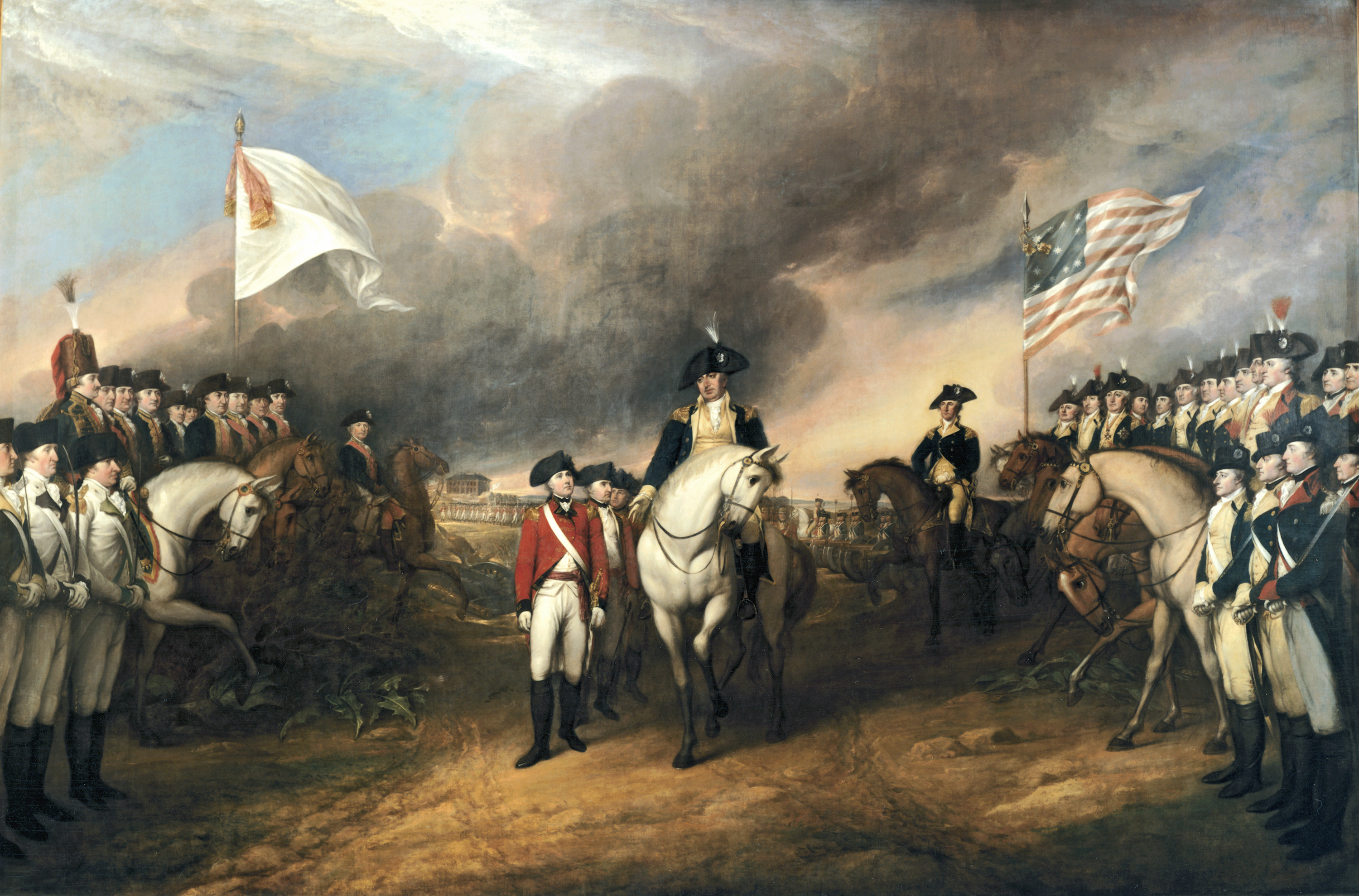
- Light Company participated in battle of Yorktown
Surrender at Yorktown
(John Trumbull)
- November, 1781
- Peebles continues attempts to sell his commission, but finds that Stirling's "rancor and malevolence still continues", so the retirement must wait until after Stirling is no longer in the picture.
- 6 February, 1782
- Approval given to Peebles to sell captaincy and retire.
- 8 February, 1782
- Peebles assembles and speaks to the Grenadiers:
Royal Highland Grenadiers I am sorry that I am going soon to leave you - in doing which I very much regret my leaving so respectable a Regt. & Corps as that to which I belong, & the Company I have the honour to Command, which whom I have served so long with satisfaction & pleasere to myself. If any of you has any claims or demands on me as your Captain I shall remain here for some days yet & will readily listen to them & satisfy them with justice & as I intent to take the first opportunity of going home to Scotland, if you have any letters to send, or anything that I can do for you there I will do it with pleasure; And Gentlemen, I earnestly hope that you will always preserve that good name you are so justly possess'd of whether in Qrs. or the field, And in all your future services I sincerely wish you all, that honour, Success, & happiness which your merit & good behaviour so well deserves. Peebles, p. 507
- Summer 1782
- While stationed at Paulus Hook, one private named Anderson
was court martialed and shot for desertion, the first desertion
since 1743.
- 22 October, 1783
- Left New York for Halifax, Nova Scotia.
- 1786
- Left Halifax for Cape Breton.
- August, 1789
- Regiment returned to Scotland, arriving in Glasgow in May
1790.
Losses in the Revolution
| Killed
|
Wounded
|
|
|
|
Officers
|
Serjeants
|
Drummers and Rank and File
|
Officers
|
Serjeants
|
Drummers and Rank and File
|
| 1776,
|
August 22nd and 27th, Long Island, including the battle of Brooklyn
|
...
|
...
|
5
|
1
|
1
|
19
|
|
|
September 16th, York Island Supporting Light Infantry
|
1
|
1
|
3
|
3
|
3
|
47
|
|
|
November 16th, Attack on Fort Washington
|
...
|
1
|
10
|
3
|
4
|
66
|
|
|
December 22nd, At Black Horse, on the Delaware
|
...
|
...
|
1
|
...
|
1
|
6
|
| 1777,
|
February 13th, At Amboy, Grenadier Company
|
...
|
...
|
3
|
...
|
3
|
17
|
|
|
May 10th, Piscataqua, Jerseys
|
...
|
3
|
9
|
2
|
3
|
30
|
|
|
September 11th, Battle of Brandywine
|
...
|
...
|
6
|
...
|
1
|
15
|
|
|
October 5th, Battle of Germantown, the light company
|
...
|
1
|
...
|
...
|
...
|
4
|
| 1778,
|
March 22nd, Foraging parties, Jerseys
|
...
|
...
|
...
|
...
|
...
|
4
|
|
|
June 28th, Battle of Monmouth, Jerseys
|
...
|
2
|
20
|
1
|
1
|
17
|
| 1779,
|
February 26th, Elizabethtown, Jerseys
|
...
|
...
|
...
|
...
|
...
|
9
|
| 1780,
|
April and May to 12th, Siege of Charleston
|
1
|
...
|
12
|
1
|
...
|
14
|
|
|
March 16th, Detachment sent to forage from New York to the Jerseys
|
...
|
...
|
...
|
1
|
...
|
3
|
| 1781,
|
September and October. Yorktown, in Virginia, light company
|
...
|
1
|
5
|
...
|
...
|
6
|
|
|
Total
|
2
|
9
|
74
|
12
|
17
|
257
|
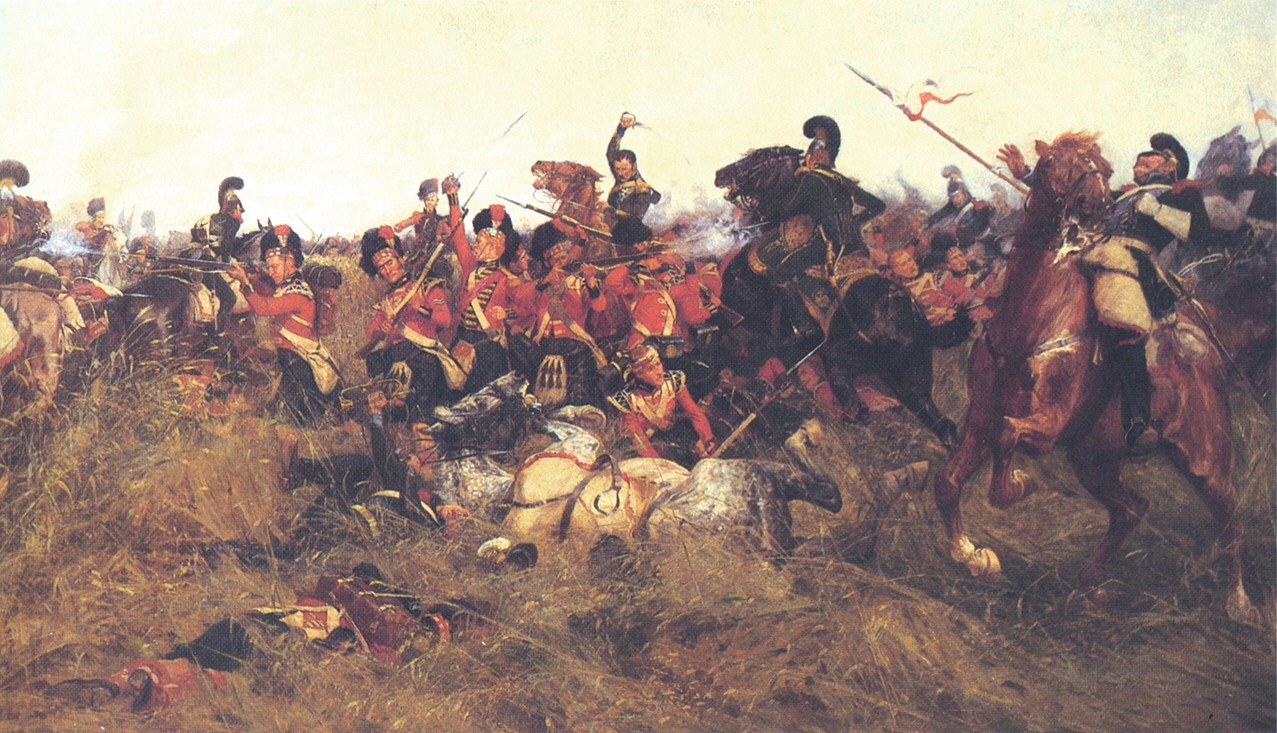
The Black Watch at Bay,
at Quatre Bras, 1815
Painter: William Barnes Wollen
After leaving North America, the 42nd, now commonly referred to as "The Black Watch" served in Flanders, Gibraltar, Minorca, Egypt, Corunna, the Penninsular Wars - at Quatre Bras and Waterloo, the Crimean War, South Africa, served in India, both World Wars, Korea, and was the last British regiment in Hong Kong before its return to China.
In the 21st Century, the Black Watch has fought in Iraq and Afghanistan.

3SCOTS (the Black Watch) in Afghanistan
View the 42nd's North American service in map form
View The 42nd Highlanders in North America in a larger map
For further references, look at the
Highland Regiment Bibliography
psmith@42ndRHR.org
http://www.42ndRHR.org
Last modified: April 12, 2021
Copyright © 2013
Preston M. Smith and the 42nd Royal Highlanders, Inc.
All rights reserved.
Blog |
Main Page |
Pipes |
Fifes |
Drums |
Dancing |
Escort to the Colors |
Pictures |
Booking the 42nd |
History |
Maps |
DeChartres |
Ireland |
Uniforms |
Warrants & Inspections |
Rev. War Officer Lists |
Links |
Bibliography |
42nd Recordings |
42nd Merchandise |
Griffin Endowment |
Scottish Society |
Burns Supper |
Forfar Bridie Booth |
The Whole 9 Yards |
Golf Outing |
2013 Tour of Scotland
|